

By Ailsa Hesketh, Founder & Managing Partner, Tivoli Legal, Cheltenham.
Last updated: 10/11/2026
Table of Contents
Key insights
- Tivoli Legal uses technology to improve paperwork efficiency and security, while ensuring solicitors remain responsible for all legal advice.
- Every equity release case at Tivoli is solicitor-led. Solicitors are accessible, giving homeowners and financial advisers confidence that we prioritise their needs.
- Tivoli Legal doesn’t insist our clients use technology they’re not comfortable with. Homeowners can call us, send documents by post, and, of course, there is always a face-to-face meeting either in our office or at the client’s home.
- We implement stringent multi-factor checks before approving payments, with a dedicated professional confirming each transaction to safeguard client funds and data.
- Delays in equity release cases often stem from legal complexities, such as title issues and complex lender requirements. This underscores the need for a specialist solicitor to navigate these challenges efficiently.
Introduction
Equity release has no property chain, so why do cases still stall? Equity Release Council figures for early 2026 showed lending down 14% year on year, even though 45% of adviser firms reported more enquiries. The Council’s Former Chair, David Burrowes, called it “a delay in cases coming through.”
Some of that is the market. But legal issues, such as title deeds that aren’t in order, slow cases down too, and every case must complete before the lender’s offer expires.
So, with AI now so widely used, does AI have a role in equity release? Yes, but only behind the scenes, and never in place of a solicitor.
At Tivoli Legal, we’ve seen what technology does well, and where a solicitor should be involved.
I’m Ailsa Hesketh, Founder and Managing Partner of Tivoli Legal, a specialist equity release firm. Our team has 80+ years’ combined solicitor experience, and we’re proud to be Equity Release Council members and CQS accredited.
Here, I’ll show you where we use technology, where we never will, and what that means for you and your financial adviser. If you’d like to see how the process works first, our equity release conveyancing page is a good place to start.
Why do equity release cases still face delays when technology is faster than ever?
According to the Equity Release Council, if everything is straightforward, the final stage after you’ve signed your documents should take “a week or two”. Cases slow down when something isn’t straightforward. Common causes of delay include:
- Title deeds that aren’t in order, such as restrictions on the title.
- Leases, trusts and transfers of equity that need extra legal work.
- Lender-specific conditions, such as septic tanks and solar panels.
- Offer conditions that nobody anticipated at the start of the case.
- Busy lenders and providers, which the Council itself acknowledges can cause delays.
- Offers that run close to their expiry date while issues are resolved.
But from my perspective, there’s more to it.
Let me explain.
In the past, qualified lawyers did all the work with admin support. Today, many firms rely on large paralegal teams, often working from home, so there are fewer quick “can you check this?” “tea point” moments such that micro-learnings happen less. Additionally, as competitive pricing piles caseloads high, a perfect storm of inexperience and overwork can mean cases aren’t reviewed as frequently or as analytically as they could be.
While equity release doesn’t normally have a chain (unless a purchase case, or linked to a contingent event such as a final matrimonial court order or lease extension), that doesn’t mean there aren’t delays. Title issues, complex leases or trusts requiring third-party involvement, and each lender’s evidence requirements all set the pace.
At Tivoli Legal, we limit equity release delays by:
- A solicitor assessing the case at instruction.
- Predicting lender requirements before the offer.
- Asking for paperwork up front.
- Commencing any additional work as soon as practically possible
Taking these steps means straightforward cases typically complete within three to four weeks after the offer arrives.
My team also manages expectations.
We’re clear that we’re only as quick as the slowest link in the process, so we explain any potential delay early to give clients clarity and confidence and, if necessary, what they can do to assist in minimising this delay
Do equity release solicitors use AI, and is it regulated?
Many solicitors now use AI to support administration, research, and efficiency.
Talking to Personnel Today, Ian Jeffrey, chief executive of the Law Society, said that over half of solicitors use or have trialled AI. To help the legal sector navigate this, the Law Society has published guidance along with a checklist for using AI responsibly. It has also developed an AI strategy.
However, AI isn’t there to make the final decisions.
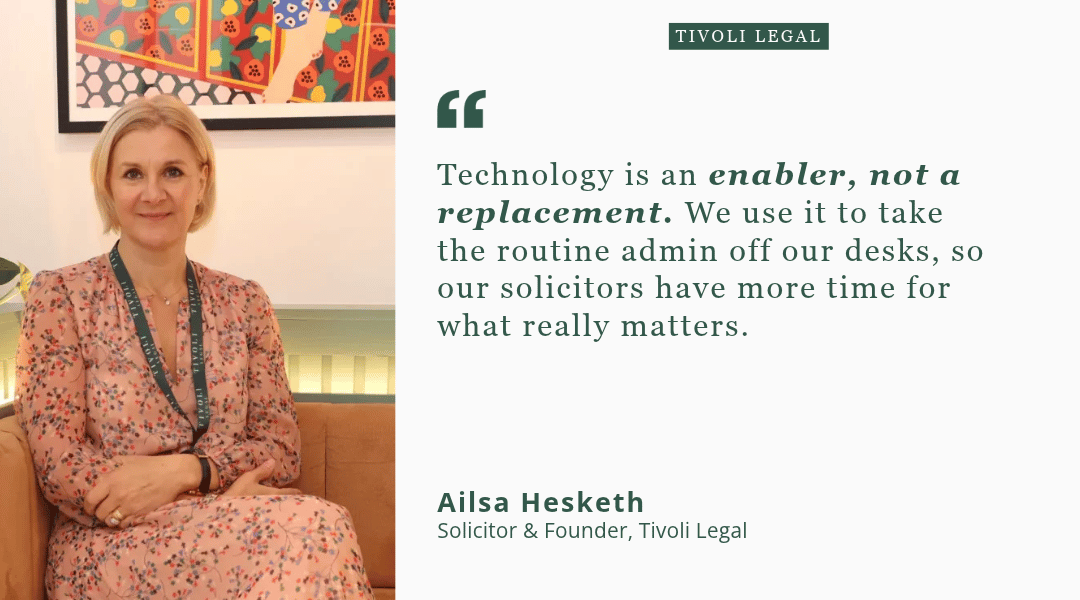
“I find AI is a useful tool for pointing us to the right rules, but it is not a panacea. We read those rules ourselves, check them, and apply them to each client’s circumstances. That requires expertise that AI and automation lack.” – Ailsa Hesketh, solicitor & founder of Tivoli Legal, Cheltenham
Equity release has an additional safeguard because every homeowner must receive independent legal advice from their solicitor before proceeding. It’s a conversation you can’t automate. It ensures you fully understand the implications of releasing equity from your home and that the decision is right for you.
So the question isn’t whether a firm uses AI. It’s how, and who checks it.
How does Tivoli Legal use AI in equity release?
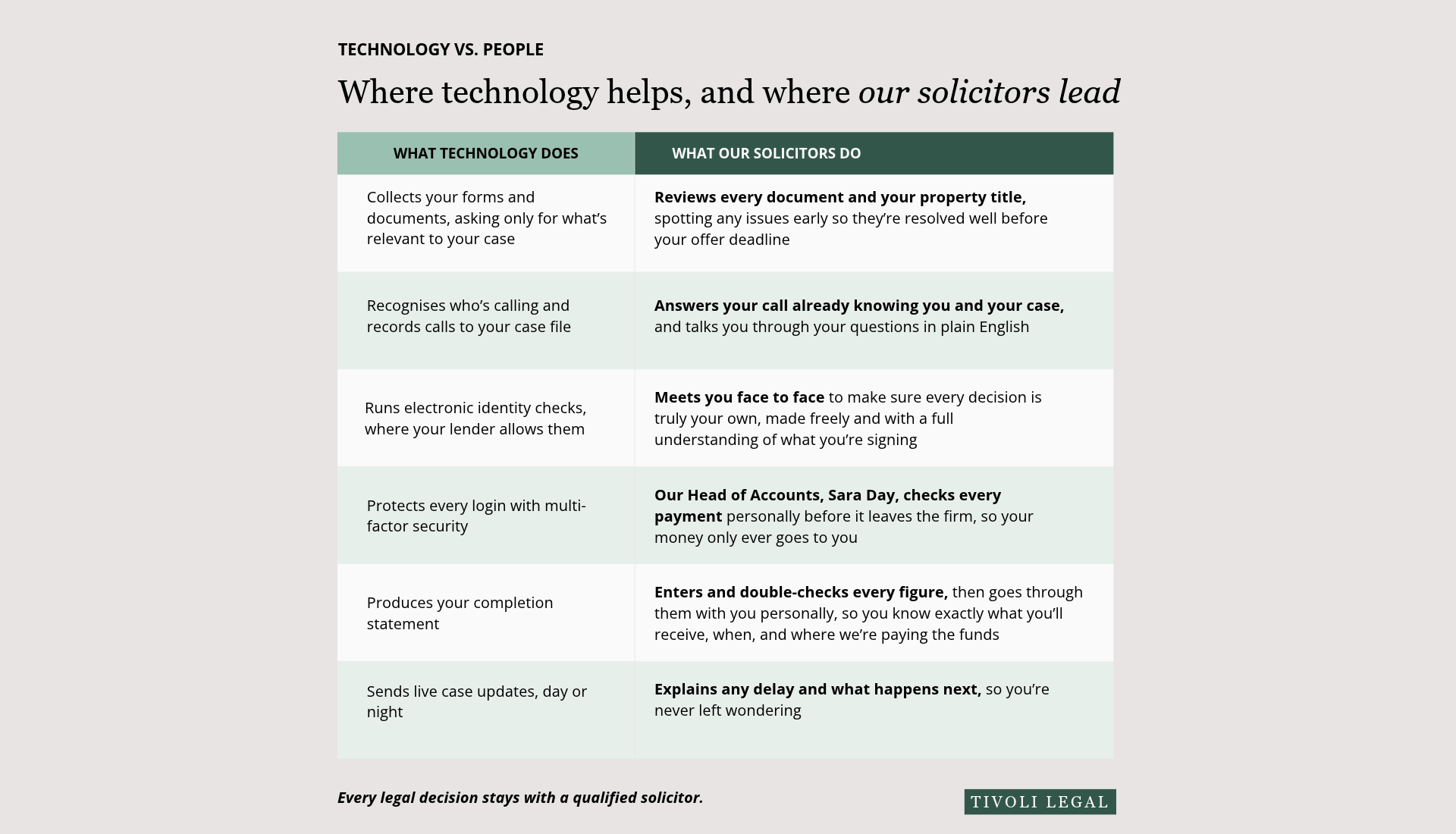
As I explained earlier, AI in conveyancing has a genuine role, and we use it for routine and security tasks behind the scenes. Smart forms, a phone system that recognises callers, secure logins and an optional case-tracking app save time and keep your data safe.
Every legal decision and conversation about your case stays with a qualified solicitor, but AI does have a place at Tivoli Legal, and this is how we use it:
Smart forms that get the paperwork right the first time
Our forms only ask for what’s relevant to you, such as mortgage statements or lease details, and prompt you to upload them as you go. I like to call this “mistake-proofing”.
We spot complications early in the equity release process, not close to your offer deadline.
A phone system that knows who’s calling
When used well, technology makes our service more personal, not less.
Whether you’re the equity release client or the financial adviser, a real person always answers, and our technology gets the call to the right person. This ensures the person answering understands your situation and can pick up the conversation immediately, rather than treating you like a case number, and there is no awful hold music whilst you are passed around a telephony system!
“Ailsa always picked up the phone and answered my many, many questions. It was clear she knew her stuff and no corners were ever cut.”
“I wanted to thank you so much for your support throughout the journey. I fear at times I leaned on you for more than just legal support. I would recommend Tivoli Legal to anyone who will listen.”
Secure systems behind every case
Every login uses multi-factor authentication, and we follow CQS and Law Society procedures with strict anti-money laundering checks. Our fraud section below explains how we protect your money.
Electronic ID, where lenders allow it
A live facial scan checked against passport biometrics is more secure than the human eye. Equity release lenders don’t accept e-ID, so we still follow the lender’s rules and certify passport copies by hand at the face-to-face appointment, adopting a belt-and-braces approach to ID verification.
An optional case tracking app
Our case tracking app offers 24/7 updates, documents, e-signature, and chat, with live reporting for financial advisers, but it’s entirely optional and can be used passively; i.e., it notifies you by email/phone when various milestones are reached.
When should AI not be used in equity release?
For me, the question isn’t whether AI can replace solicitors. The better question is whether technology should replace human judgement in equity release, and there are very good reasons why that shouldn’t be allowed to happen.
Equity release is full of legal grey areas that need experienced lawyers who understand property law (and frequently wider areas such as contract, matrimonial, trusts and insolvency), equity release and lender requirements. This distinction matters because the fast answers you’ll get from AI aren’t always the right ones and often fail to consider all nuances, apply them to the property title, lender requirements and client circumstances/objectives.
We’ve seen examples across the wider conveyancing industry where technology creates enquiries quickly, but not necessarily accurate outputs. Often, in our experience, this makes the conveyancing sale/purchase process more drawn-out and painful by raising nonsensical or irrelevant enquiries. In equity release, small details can have significant consequences, so we believe accuracy should always come before speed.
That’s why we never use AI to:
- Give legal advice or explain your lifetime mortgage offer: You get a specialist solicitor’s independent legal advice every time.
- Decide what a title problem means: Title plan errors, restrictions, trusts, leased solar panels, transfers after divorce or bereavement need expert judgement, not generic answers.
- Answer lender requirements: Every lender sets its own evidence rules, and they keep changing them. It takes experience and expertise to understand how to satisfy them.
- Speak to a worried client: We understand that equity release can be a difficult decision, and our clients are often already facing a stressful situation. We support them during the process in a way AI can’t.
- Make the final call on legal research: AI may point us towards the right rules, but a solicitor verifies sources, reads, checks, and applies them to the bespoke circumstances of the clients’ transaction.
Equity release is one of the biggest financial decisions many homeowners will ever make. That’s why we believe technology should support solicitors, not replace them.
Do you have to use technology for equity release as a homeowner?
To put your mind at rest, technology is optional at Tivoli Legal. Research shows that many people in later life don’t use technology regularly, and others find that life is harder now that many services have moved online.
We understand that everybody has different preferences for managing their transaction. Some clients prefer using online tools and digital updates. Others prefer a phone call and paper documents. The choice is always yours, and we will ask you this in our initial introductory call on day one.
You can speak to an equity release solicitor by phone, send us post, and meet us in the office or in your home, face to face. We work in the way that’s most comfortable for you.
That approach is reflected in our client feedback. One reviewer, Kate M., described Tivoli Legal as “extremely helpful across a complex equity release process. Everyone I dealt with was efficient, well informed, reassuring and courteous.”
How Tivoli Legal protects equity release funds from fraud
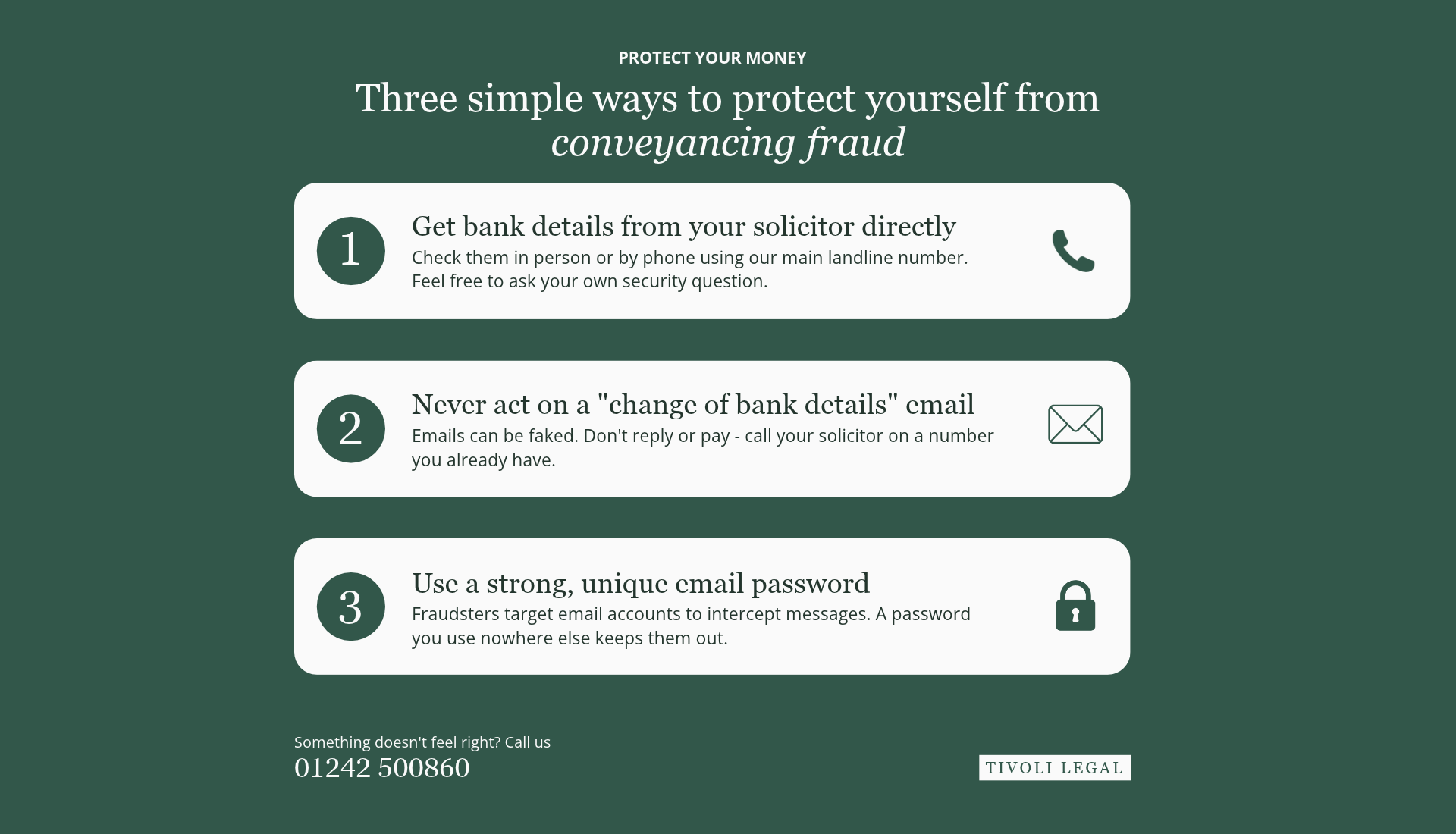
Protecting your money is just as important as completing the legal work itself. Equity release funds should be protected by multiple layers of checks, including identity verification, secure systems, payment authorisations, and personal conversations with clients.
Conveyancing fraud has increased significantly, especially in residential property transactions. Naturally, we want to do everything possible to protect you, and that’s something our head of finance, Sara Day, dedicates her working day to.
“I look after all of our clients as I would treat my own parents. And every penny of their money is safeguarded as if it were my own.” – Sara Day, Head of Accounts, Tivoli Legal
Additionally, we protect your equity release funds with:
- Checks and double-checking.
- Secure multi-factor system logins.
- Confirming bank details.
- Completing identity and capacity checks.
- Calling and confirming with both applicants before completion.
- A solicitor and an accounts team that reviews every payment before it leaves the firm.
These measures have helped us prevent or discover fraud/potential fraud many times, including:
- Carer overspending: a client spending around £1,000 a month on shopping, which turned out to be a carer pocketing the difference.
- The £100k kitchen: a client quoting £100,000 for a new kitchen in a small bungalow, which didn’t add up.
- Impersonation: adult children pretending to be their parent on the phone.
- Care fees: an offer releasing around £500,000 lump sum for a 90-year-old when care costs were about £60,000 a year, resolved by changing to a drawdown product.
- Overseas romance scam: a client was using equity release to fund his USA girlfriend to pay inheritance tax on her deceased parents’ property. He had told his adviser that he was buying a holiday home in Florida, but the reality was more complex. He was taking on trust that once that house was sold, they would get married and buy a house together, but on investigation, they had not met, and there was no evidence of the deceased parents’ house.
What these situations have in common is that something simply didn’t feel right. That is why human oversight remains so important. Technology can flag unusual activity, but expertise, conversation, and professional judgement often uncover the real story.
Why every equity release case is solicitor-led at Tivoli Legal
At Tivoli Legal, everything is solicitor-led. For our clients, that means you work with a named, experienced person throughout; that’s not the case with every law firm.
Other firms take a segmented approach: One person onboards, another reviews the title, and another member chases up. Clients are left repeating themselves to different team members, while paralegals can act as gatekeepers.
And sometimes, high-volume firms split cases between teams and paralegals, which delays responses and can cause equity release offers to lapse.
We don’t let this happen at Tivoli Legal.
Working side by side in the office means we collaborate instantly if a problem arises. If there’s ever a question, no matter how small, we discuss it straight away. It makes the whole process smoother for everyone, including financial advisers, and it means that we all collectively continue to gain micro-learnings day in, day out
For example, if a client inherits a property overseas and asks how that affects their equity release application, we don’t have to send the question through multiple departments and wait days for a reply. We can provide practical guidance straight away.
I like to use the example of a client inheriting a house in Canada and needing quick advice on the wider implications. Those conversations work best when experienced people work together.
This collaborative approach helps financial advisers too. When an adviser calls us, they speak to the solicitor handling the case, not a gatekeeper. They get a clear answer quickly, and there’s less risk of an offer lapsing while questions are passed around.
What should an adviser look for in an equity release solicitor?
Financial advisers should look for a specialist that:
- Is experienced in equity release, solicitor-led, with a proven outcome-based track record.
- Proactive communications, including direct dial phone numbers that are always answered.
- Understands and pre-empts lender requirements.
These are all essential elements that protect the offer window, keep clients reassured, and mean fewer calls for the adviser.
“We’re aware that by the time a client reaches us, their adviser may have spent weeks or months building trust and identifying the right solution. Our role is to carry that trust forward.” – Ailsa Hesketh, solicitor & founder, Tivoli Legal.
Here’s how we achieve that:
- A qualified solicitor leads every case: An experienced lawyer handles each equity release file from instruction to completion and answers advisers’ calls directly.
- We check lender requirements at instruction: Tivoli Legal anticipates what the lender will ask for before issuing the offer. It flags complications such as trusts, transfers of equity and unregistered title at the start of the case.
- We front-load paperwork: Tivoli Legal gathers documents up front, so documentation packs can go out the same day.
- Progress is visible in a live case tracking app: Advisers can follow each case and view reporting on their clients’ cases at any time.
- Our track record is checkable: We have completed documentation within anticipated timescales in 100% of cases, and we offer a “no completion, no fee” guarantee.
Conclusion – Technology that helps, solicitors who you’ll get to know personally
As the Equity Release Council has highlighted, cases can slow down even when demand is strong. The answer isn’t technology removing people from the process. It’s experienced solicitors who anticipate problems from day one and use technology to smooth the process.
At our solicitor-led practice, we understand where technology and AI fit in equity release. Technology helps us work efficiently, communicate clearly, and keep your information secure. The advice, judgment and support still come from real people who take the time to get to know you.
“Your home is your biggest asset; releasing equity from it is a deeply personal choice, so it deserves more than a transactional approach. For genuine peace of mind, lasting security, and complete compliance, you deserve specialists who truly care about you and your future.” – Ailsa Hesketh, solicitor & founder, Tivoli Legal.
How we can help:
For homeowners
Thinking about equity release, or have a question about the legal side? Our solicitors are here to help.
- Call us on 01242 500860
- Ask our solicitors a question
- Download our free equity release guide
For financial advisers
Looking for a solicitor-led partner who protects your clients’ interests and delivers a 5-star service?
About the author

Ailsa Hesketh, Founder & Managing Partner, Tivoli Legal, Cheltenham
With over 28 years of experience as a qualified solicitor, Ailsa Hesketh founded Tivoli Legal to elevate the standard of legal services in the equity release industry.
Recognising that a lack of expertise can lead to late issue identification, insufficient documentation for lenders, and complications from unique situations, Ailsa is dedicated to preventing the stress and potential offer rejections clients can encounter.
Ailsa is committed to transforming the client experience by delivering exceptional, efficient, high-quality service in a professional, friendly, and empathetic manner.
FAQs about AI use in conveyancing
Can AI replace my equity release solicitor?
No. You must have your own solicitor, and independent legal advice is a face-to-face conversation about a lifelong commitment.
How long does equity release take?
Straightforward cases often complete three to four weeks after the offer arrives (per Tivoli’s FAQs); more complex cases, e.g. trusts, unregistered titles or transfers, take longer.
Can I choose my own solicitor for equity release?
Yes. Having your own solicitor is a legal requirement for equity release, and it’s your choice who represents you. Ask your adviser to instruct us, or contact us directly.
Can I use electronic ID for equity release?
Not usually yet: ER lenders still ask for certified passport copies. We’ll tell you exactly what your lender needs.
What should I do if I get an email changing my solicitor’s bank details?
Don’t reply or pay. Call your solicitor on a number you already have, and report it to Action Fraud.
Can my financial adviser speak to my solicitor directly?
Yes, with your permission. Advisers can call the solicitor running your case and see progress in the app.